


Recruiting a Field Service Engineer
Field service engineers install, maintain, repair and validate equipment in hospitals and labs. How to settle which job you are opening, where the engineers come from, and why hospital credentialing decides when a new hire can first walk into an account.
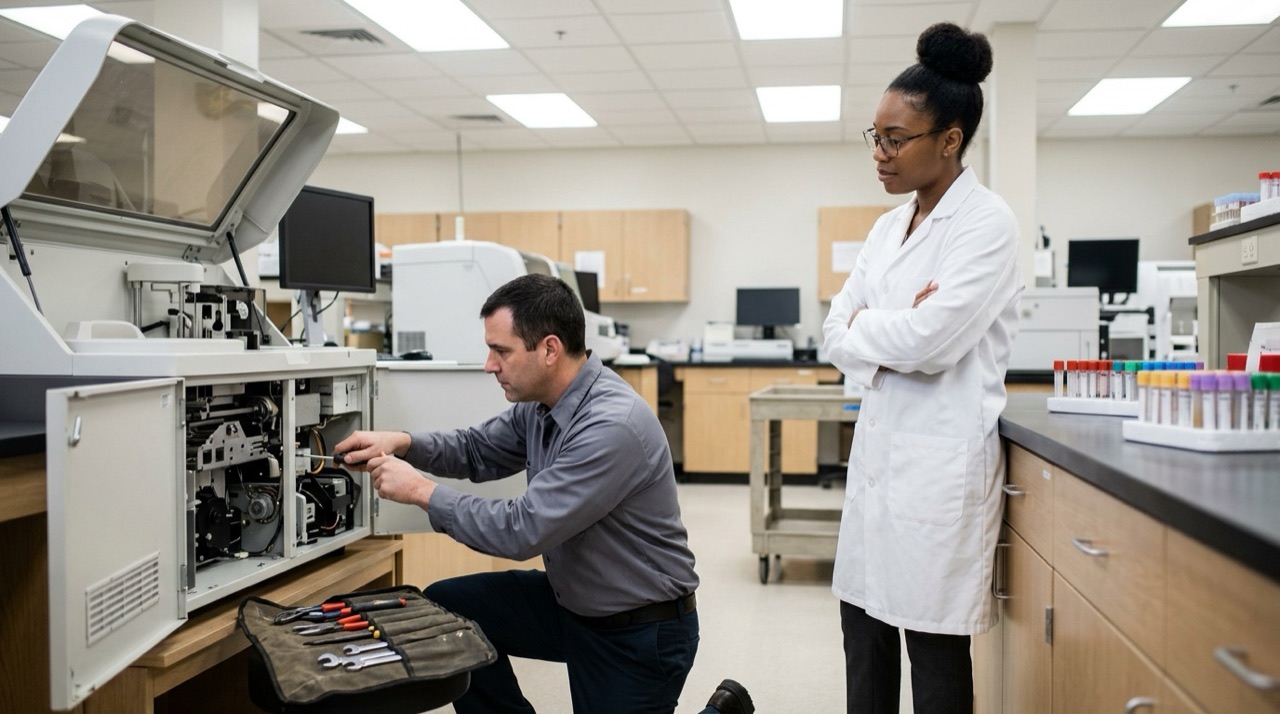

A bench repair requisition and a field service engineer requisition read almost the same on paper. A field service engineer drives a territory, badges in past a credentialing desk, and stands next to a lab manager explaining why the analyzer went down mid-run. We ask which one you mean before anything else, because the answer sets who the candidates are, the pay structure and the earliest date anybody can walk into an account.
- Depot, field and applications are different jobs sharing a job title. Settle which one you are opening before the posting goes out.
- Vendor credentialing at a health system is a step with its own timeline, and the health system sets it.
- OEM service, third-party service organizations, the military and hospital clinical engineering all produce field service engineers, and they arrive with different gaps.
- Name the territory, the overnight nights and the on-call rotation in the posting. Candidates learn them either way, and leaving them out only changes who applies.
- The technical screen needs someone who has carried the toolkit and can tell whether a candidate did the work themselves or is describing their team's.
We recruit field service engineers and service leaders across medical device and diagnostics, and this is the order we work through with a service director, VP of operations or GM. Selling the system is a different hire, covered in the capital equipment sales rep playbook.
Settle the variant before the posting goes out
Depot and field are the first fork. A depot engineer works on systems that come to them, with the bench, the tooling and a colleague down the hall. A field engineer works alone in somebody else's building, on somebody else's schedule, with whatever is in the vehicle.
Modality is the second fork. Imaging service runs on a preventive maintenance calendar and long service agreements. Lab analyzer service runs against turnaround time and the reagent business behind the instrument. Surgical capital service runs around a block schedule, so some days the engineer stands in a hallway waiting for a case that ran long.
Then service against applications. Applications specialists train users and run assays. Service engineers fix hardware. A posting asking for board-level repair alongside protocol training has described two people, and the clinical specialist playbook covers the applications half.
Start credentialing at the finalist stage
Most health systems run vendor access through a credentialing program, separate from your own background check. Expect immunization records, usually measles, mumps and rubella titers, varicella, a tuberculosis screen and a flu shot in season, plus the program's own background check and training modules on infection control and patient privacy. A territory role adds a motor vehicle record pull, and a driving history a plant job would ignore can be disqualifying here.
We name the credentialing program and the immunization list in the first candidate conversation, well before the offer letter. Someone out of a hospital clinical engineering department usually has it all current. Someone off a bench often does not, and the gap between an accepted offer and a first customer visit stays open while a titer is redrawn.
Know where your candidates come from
OEM service organizations produce engineers trained on one modality, used to a parts depot, an escalation path and documented procedures. If your platform is close to theirs, they get up to speed quickly. Ask early whether factory training carried a repayment agreement, because it surfaces late otherwise.
Third-party independent service organizations produce engineers who cover several manufacturers without the original documentation or tooling. Some need time to adjust to working inside a manufacturer's quality system.
The military produces biomedical equipment technicians with strong fundamentals and a documentation habit built in, though most have not owned an account relationship or a service contract conversation. Availability is tied to a separation date, which you can know months ahead.
Hospital clinical engineering and HTM departments produce engineers already credentialed and on the customer's side of the table, usually without depth on one platform or any history of living in a car.
Among the searches we have run are a field service engineer and a field service engineer manager for a growth-stage diagnostics company.
Put the travel and the rotation in the posting
Name the territory by the states and airports it covers. Put a number on the overnight nights in a normal month, using the one your current team actually hits. Say how the on-call rotation works and whether a phone tier sits before a dispatch.
Describe the install base: how many systems, which generations, how much sits under contract. Then say whether the person is measured on uptime and response time or on an install and upgrade schedule. If the role carries a service contract attach number, print it, or someone who thought they were taking an engineering job reads it later as a switch.
Interview the troubleshooting out loud
Ask for a failure they could not solve on the first visit. Listen for the sequence: what they measured, what they ruled out, which documentation they pulled, when they escalated, what they told the customer meanwhile. A weak answer is a list of parts they swapped. A strong one has an order to it and a decision about when to call for help.
Then test the room. Ask what they did the last time they had to tell a lab or an OR that the part would not land until tomorrow, and listen to how they handled the hour after the bad news.
Run that part of the screen with someone who has done the job, because a lead engineer hears whether a candidate is describing their own hands or the team's.
Compare the whole pay package
Pay structures vary widely between employers, even for the same title. Some roles are overtime-eligible and some are salaried. On-call time might earn a stipend, a per-call rate, or nothing. There might be a company vehicle with fuel and maintenance, or mileage. Overnights may carry per diem, and some roles pay a bonus tied to uptime.
An engineer moving from an overtime-eligible role to a salaried one trades a variable number they can predict for a fixed one. If nobody says that out loud, in our experience they work it out later and decline. Get the vehicle right in the offer.
Two ways this goes wrong
The first is hiring for technical skill alone. A strong bench technician lands in a job that is mostly customer relationship with a toolkit attached. The technical work is fine, and the account complaints start a few months in.
The second is a slow process with credentialing idle behind it. The candidate accepts, then waits on a check and an immunization record nobody started. Field service engineers are competitive and in demand, and a candidate left waiting for a month can take another offer.
Roles covered: Field Service Engineer, Senior Field Service Engineer
What this role pays
Base salary and total compensation at target by sector, from the Jacobs Management Group 2026-2027 Compensation & Hiring Report:
| Sector and title | Base salary | Total compensation at target |
|---|---|---|
| Medical Device: Field Service Engineer | $61K to $96K | $67K to $106K |
| Diagnostics: Field Service Engineer | $68K to $89K | $75K to $98K |
Mid-cap ranges for medical device, pharmaceutical and biotech, and diagnostics; one range across company stages for CDMOs, CROs and life science agencies.
- What is the difference between a field service engineer and an applications specialist?
- A field service engineer installs, maintains, repairs and validates the hardware. An applications specialist trains the users, runs the assays or protocols, and drives utilization once the system is working. Both roles are field-based and customer-facing, and job descriptions often merge them. When the instrument goes down, the service engineer is the one holding the tools.
- Can a new field service engineer start visiting hospital accounts as soon as they are hired?
- No. Access to clinical space at most health systems runs through a vendor credentialing program that verifies immunization records, runs its own background check and requires training modules, and it moves on the health system's timeline. Treat it as a step with its own schedule and start it at the finalist stage, or a signed offer sits idle while paperwork clears.
- Do military biomedical equipment technicians transfer into commercial field service roles?
- Yes. The fundamentals usually transfer cleanly, including diagnostic discipline, documentation habits and comfort working on regulated equipment without hand-holding. What is new is the commercial side, meaning account ownership, service contract conversations and a territory they plan themselves. Separation dates are known well in advance, so you can plan a start date months ahead.
- How do I settle which field service job I am opening?
- Depot versus field is the first fork. A depot engineer works on systems that come to them, with the bench and a colleague down the hall; a field engineer works alone in somebody else's building, on somebody else's schedule. Modality is the second fork.
- Where do field service engineers come from?
- OEM service organizations produce engineers trained on one modality, used to a parts depot, an escalation path and documented procedures. If your platform is close to theirs, they get up to speed quickly. Ask early whether factory training carried a repayment agreement, because it surfaces late otherwise.
- Third-party independent service organizations produce engineers who cover several manufacturers without the original documentation or tooling. Some need time to adjust to working inside a manufacturer's quality system.
- The military produces biomedical equipment technicians with strong fundamentals and a documentation habit built in, though most have not owned an account relationship or a service contract conversation. Availability is tied to a separation date, which you can know months ahead.
- Hospital clinical engineering and HTM departments produce engineers already credentialed and on the customer's side of the table, usually without depth on one platform or any history of living in a car.
- Among the searches we have run are a field service engineer and a field service engineer manager for a growth-stage diagnostics company.
- How do I interview a field service engineer on troubleshooting?
- Ask for a failure they could not solve on the first visit and listen for the sequence: what they measured, what they ruled out, which documentation they pulled, when they escalated and what they told the customer. A weak answer is a list of parts they swapped.
- What should the posting say about travel and on-call?
- Name the territory by states and airports, put a number on overnight nights in a normal month, say how the on-call rotation works, and describe the install base.
- What should we budget for a Field Service Engineer?
- Budget a base salary of $61K to $96K and total compensation at target of $67K to $106K at a mid-cap medical device company, per the Jacobs Management Group 2026-2027 Compensation & Hiring Report. The low end fits a hire new to the level and the high end an experienced hire who has done the job before; most offers land between the two. The table above gives the other sectors.
We recruit field service engineers in every state
Jacobs Management Group recruits field service engineers nationwide, including territories with no major life sciences hub nearby. Field roles are frequently filled through national sourcing. The employer is often based in another state, and the candidates we look for first are people who already live in or near the territory.
How nationwide recruiting worksHave a search in mind?
We'll set up a scoping call, comp data, an estimate of how many candidates fit, and a realistic timeline.
CandidatesLooking for your next role?