


Recruiting a Director of Manufacturing Operations
The calls that define this job all cost something: a held lot, a missed ship date, a quarter of overtime. The best interview questions put a finalist back inside one of those calls and listen to how they paid for it.
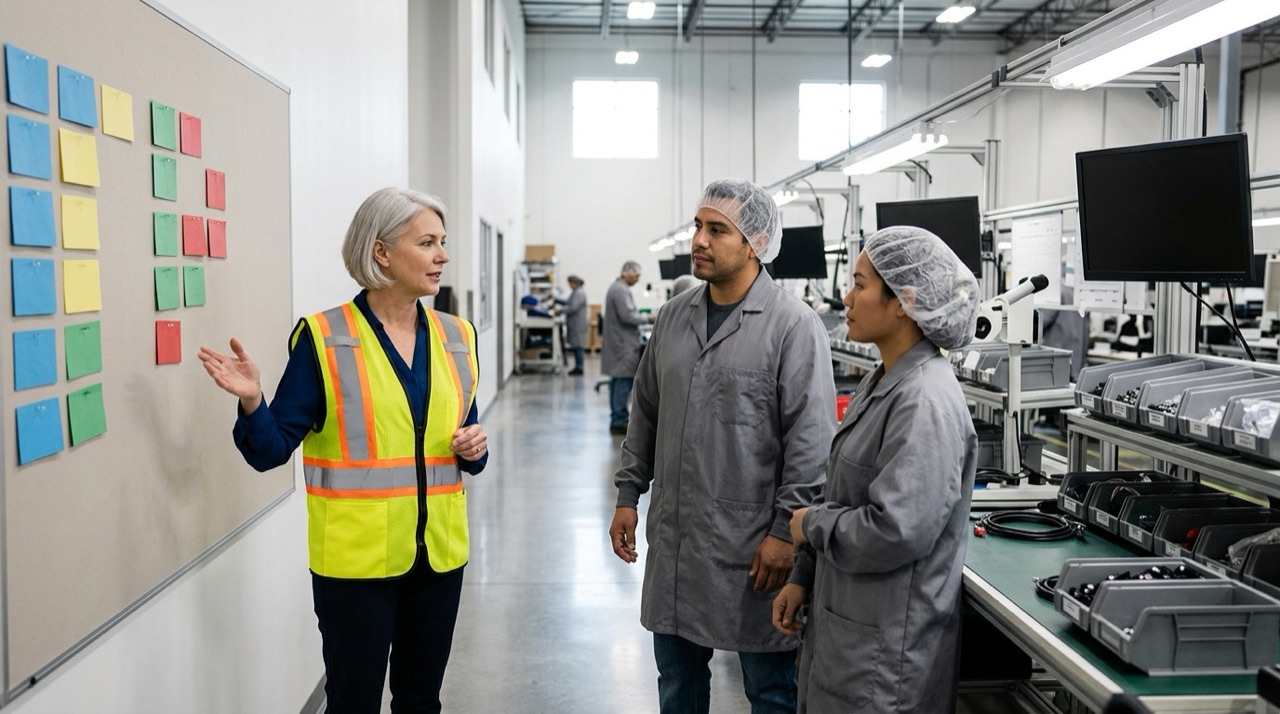

The questions that tell you most about a manufacturing director are the ones where every answer costs something. Hold the lot and miss the ship date. Add operators now and carry them through a slow quarter, or ask the second shift for more overtime. Anyone who has run a regulated floor has made those calls, and the way a finalist describes what the call cost tells you more than a list of the sites they have run.
- Interview questions for a director of manufacturing operations work best when every possible answer carries a cost, such as holding a lot against a committed ship date.
- A strong manufacturing director can say who they called before deciding what to do with product in process, and what the decision cost the site.
- Ask a director candidate how they handled months of heavy overtime on one shift, and listen for the numbers they were watching before they decided.
- Device manufacturing finalists can be asked how their plant prepared for the FDA Quality Management System Regulation, in effect since February 2, 2026.
These are the questions we suggest to a COO, VP of Operations or site head for the hire. Among the searches Jacobs Management Group has run in this area are a Senior Director of Manufacturing Operations for a growth-stage injectable pharma CDMO and a Director of Operations for polymer and device manufacturing at a growth-stage blood purification device company.
Settle one answer before the first interview
When we scope one of these searches with a COO, a useful first question is who decides when a line stops. It sounds settled until the head of quality and the VP of Operations answer it separately. A strong finalist asks that question in the second round, and if two interviewers give different answers, the candidate notices before you do.
So agree on it, along with who signs the batch record or device history record, and send that to every interviewer. The questions below assume quality makes the disposition call and the director owns the schedule around it.
A quality hold against the ship date
Ask: "Tell me about a lot that was ready to go out when something in the record made you uneasy. What did you hold, who did you call, and what did it cost?"
A strong answer names the thing itself, an out-of-trend result or an environmental monitoring excursion or a line clearance that was signed and not done. It says who made which call, and it puts a price on the hold in plain terms: a missed delivery, a weekend shift, a phone call to a customer they did not want to make. Listen for when they told the customer. The good ones called early.
The weak answer is a principle. "Quality always comes first" costs the speaker nothing. Follow it with "What would have had to be true for you to ship?" and you hear whether they know where the line sits.
Headcount and overtime on the same shift
Ask: "Your second shift has been on heavy overtime for three months, and the forecast says it continues. The last time you were there, what did you do?"
Strong candidates give you the numbers they watched: hours per operator, errors and near misses late in a shift, who left. They also know a new operator on a GMP line produces nothing until trained and qualified on the procedures, so the headcount decision had to be made a quarter before the overtime peaked. Ask who they had to convince in finance and what they gave up to get the requisition approved.
A deviation the week before a ship date
Ask: "A deviation opens on Tuesday. The lot is due Friday. Who is in the room, what do you need by Wednesday, and what will you refuse to do?"
The answer you want keeps the investigation and the schedule as two separate conversations, and refuses to name a root cause early to make the date. Listen for the customer again. A director coming out of a CDMO will usually tell this part in detail, because the person on the other end of the phone was a sponsor's supply lead with their own date to protect.
Scale-up from clinical to commercial supply
If your site is moving from clinical to commercial supply, ask: "What broke the first time you ran a process at full scale, and who found it?"
A strong answer is specific: a hold time that did not survive the bigger vessel, a component supplier who could not keep up, a step that worked at bench scale and failed on the line. Then listen for the credit. A director who says an operator or a technician spotted it first has usually built a floor where people speak up. Our read, and it is only a read, is that this is the most useful single question for a scale-up hire.
The people on the floor
Ask: "Which supervisor did you promote last, and what did you see in them before anyone else did?" Then: "When did you last walk the night shift, and what did you find?"
The first question gets you a person described by what they did. The second gets you a date, or a pause. The answer worth hoping for is a small thing found at two in the morning, a workaround on one machine that never made it into a procedure, and what the director did about it the next day.
Inspections, by sector
For device sites, ask how the candidate's plant prepared for the Quality Management System Regulation, which took effect on February 2, 2026 and brought ISO 13485:2016 into 21 CFR Part 820 by reference. Someone who led the gap assessment will tell you what changed on the floor and what they left alone.
For pharma and biotech sites, ask about the last inspection they hosted and what they personally fixed afterward. Have your head of quality ask it, alone.
- What should you ask a director of manufacturing operations in an interview?
- Ask about calls where every option had a cost: holding a lot against a ship date, adding operators while a shift runs on overtime, or handling a deviation days before a delivery. Ask who they called, what they decided and what it cost the site.
- Who should interview a director of manufacturing operations candidate?
- The hiring executive, usually the COO, VP of Operations or site head, plus the head of quality in a separate conversation and someone who works on the floor daily. Quality and operations should agree beforehand on who decides when a line stops, because a strong finalist will ask both of them.
- Who decides when a line stops?
- Settle this before the first interview. It sounds settled until the head of quality and the VP of Operations answer it separately, and a strong finalist will ask it in the second round.
- How do I test scale-up experience?
- Ask what broke the first time the candidate ran a process at full scale, and who found it. A strong answer is specific, such as a hold time that did not survive the bigger vessel or a step that worked at bench scale and failed on the line.
- How do I test judgment on a deviation?
- Ask about a deviation that opens on Tuesday with a lot due Friday: who is in the room, what do they need by Wednesday, and what will they refuse to do. A strong answer keeps the investigation and the schedule as separate conversations and refuses to name a root cause early to make the date.
- How does inspection preparation differ for device sites?
- Ask how the candidate's plant prepared for the Quality Management System Regulation, which took effect on February 2, 2026 and brought ISO 13485:2016 into 21 CFR Part 820 by reference. Someone who led the gap assessment can say what changed on the floor.
We recruit directors of manufacturing operations in every state
Jacobs Management Group recruits directors of manufacturing operations nationwide, including territories with no major life sciences hub nearby. Field roles are frequently filled through national sourcing. The employer is often based in another state, and the candidates we look for first are people who already live in or near the territory.
How nationwide recruiting worksHave a search in mind?
We'll set up a scoping call, comp data, an estimate of how many candidates fit, and a realistic timeline.
CandidatesLooking for your next role?