


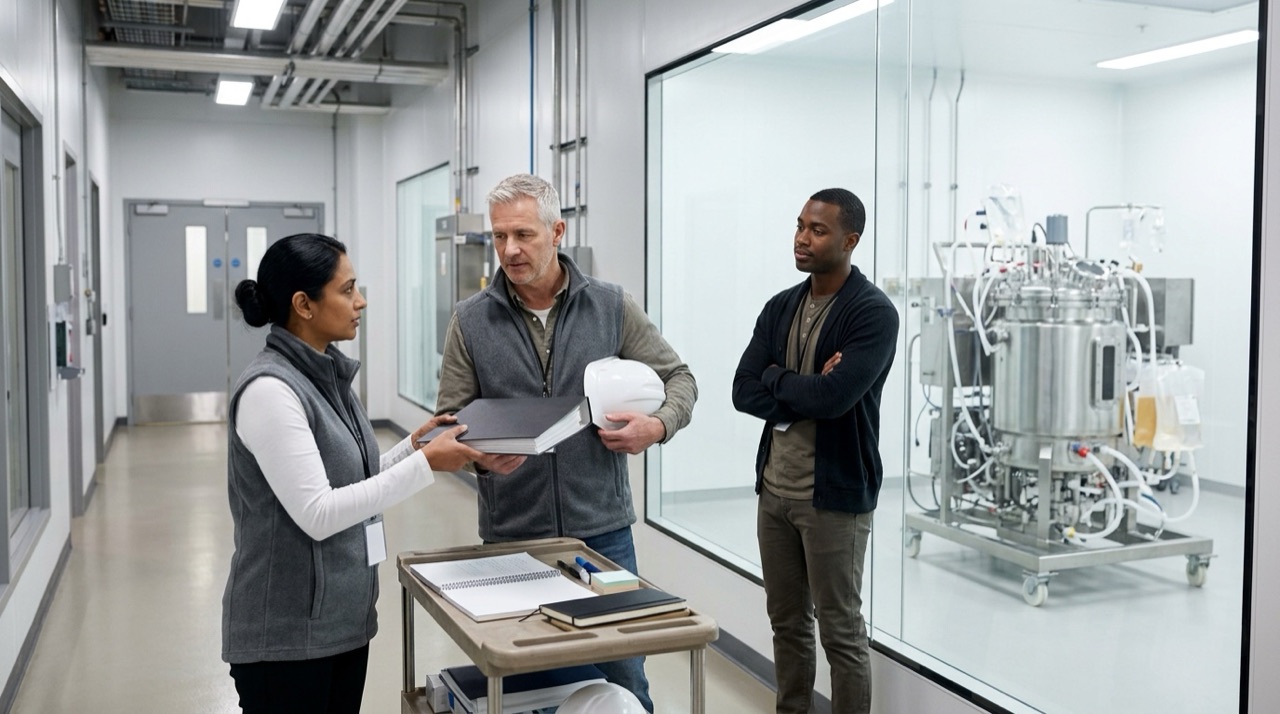

- A technology transfer lead with no hands-on manufacturing background is the most common reason a transfer slips. The job calls for translating a process onto new equipment, beyond keeping a schedule.
- Analytical and QC staff set the real pace of a transfer. Manufacturing can run in parallel across shifts. Method validation runs on its own fixed timeline and cannot be compressed the same way.
- A validation engineer decides whether a facility is cleared to run. A construction schedule that finishes on time still needs this sign-off before the line can operate, and hiring the role late is the most expensive mistake a CDMO makes.
- Business development sells the delivery date before the technical team sees the file. A thin BD bench shows up months later as a transfer delay.
The technology transfer lead
A technology transfer moves a process out of a sponsor's development lab and into someone else's manufacturing suite, with a different scale, different equipment, and a different operator standing at the line. The transfer lead owns that translation. The job is not project management with a life sciences label on it. It requires enough hands-on process history to read a batch record and know where the sponsor's lab-scale assumptions will not survive the move to a 2,000-liter bioreactor or a high-speed filling line.
Jacobs Management Group recruits for this role across small molecule, biologics, and cell and gene therapy CDMOs, and the pattern repeats regardless of modality: a transfer lead hired for their project management credentials, without recent bench or production-floor time, can run a clean timeline on paper while the actual process drifts. The deviations that follow cost more than the search would have.
Analytical and QC staff
Manufacturing capacity gets the headlines, but analytical and quality control staff are what actually gate a transfer's calendar. Before a CDMO can run a sponsor's product, its lab has to qualify and validate every test method the batch record calls for, from assay development through stability protocols. That work happens on one timeline, by a small number of people, and it cannot be split across extra shifts the way manufacturing can.
Alexandra Pecci, writing for PharmaVoice on Oct. 12, 2026, reported that quality and regulatory positions rank among the hardest manufacturing roles to fill in both North Carolina and Boston, and quoted a biomanufacturing workforce expert's description of the stakes directly: "The sites don't come online unless you have quality assurance and validation engineers" to confirm the equipment works and clears FDA approval. Jacobs Management Group's analytical and contract testing practice recruits for exactly this gap. Sponsors learn whether a CDMO's staffing matches its sales pitch in the analytical lab, often well before the first commercial batch ships.
Validation engineers
Validation is the step that turns a built facility into an operating one. It is also a narrower specialty than general manufacturing engineering. A validation engineer has to document that equipment, utilities, and cleaning procedures perform as specified, under a protocol that a regulator will eventually read. A validation engineer hired once construction wraps starts that qualification work from zero. That gap is a common way a CDMO ends up with a finished building and no start date.
Modality matters here too. A sterile injectables line and a cell and gene therapy suite validate against different risks, and a generalist engineer moved over from solid dose manufacturing needs real ramp time before signing off on either one. Jacobs Management Group's sterile injectables and fill-finish and cell and gene therapy manufacturing practices build around that distinction. Validation judgment earned on one modality has to be re-earned on another.
Business development for contract-manufacturing deals
The business development team that signs a transfer deal sets its timeline before the technical staff sees the sponsor's file. A BD hire who understands manufacturing capacity, current utilization, and the real lead time for the modality they are selling will scope a deal the operations team can hit. A BD hire selling on relationships and price alone will scope a deal the operations team cannot, and the gap surfaces as a transfer delay with the technical team's name on it.
This is a different hire than a typical life sciences sales role. It requires enough fluency in the manufacturing side of the business to negotiate a slot the operations team can actually deliver against. A signed contract alone does not guarantee that.
Where the four roles interact
These roles do not fail independently. A transfer lead without production history writes a schedule the analytical team cannot actually hit. A validation engineer hired late turns a finished facility into an idle one. A BD team that oversells capacity hands operations a date nobody downstream agreed to. The common failure is hiring each role against a generic job description instead of against what the specific modality and the specific stage of the transfer actually require.
Matching the hire to the modality
A strong resume in contract manufacturing does not automatically transfer across modality. Someone who has spent a career on oral solid dose has to build new judgment on a biologics or cell and gene therapy line, and the transfer lead or validation engineer who has not made that jump before is a different hiring risk than one who has. The specificity question, more than years of experience alone, is usually what separates a transfer that holds its date from one that does not.
Questions for each of the four roles
For the transfer lead, ask which process the candidate moved to a larger vessel or line and what did not survive the move. For analytical and QC staff, ask for the method validation timeline on the candidate's last transfer and what was on the critical path. For the validation engineer, ask what documentation the candidate completed before the facility was cleared and who signed. For business development, ask how the candidate learned the technical content of a file before quoting a delivery date. Strong answers name the process, the document or the date. Weak answers describe a general method.
Sequencing these hires
The validation engineer and the analytical lead belong early in the plan, before the facility design is fixed and before a delivery date is quoted. The transfer lead belongs before the first sponsor's process arrives. The business development team's technical review belongs before the first quote. A plan that lists these four hires against the construction schedule shows where the dependencies sit.
Where this page connects to other searches
A facility that runs several modalities needs the same four roles for each. The cell and gene therapy hiring guide covers which manufacturing and supplier roles to open early, and the CDMO account executive playbook covers the selling side.
Frequently asked questions
- What makes a technology transfer lead different from a general project manager?
- A technology transfer lead needs recent hands-on manufacturing or process development experience. Project management skill alone does not catch where a sponsor's lab-scale process will struggle to survive the move to commercial-scale equipment.
- Why do analytical and QC roles bottleneck a transfer more than manufacturing does?
- Method validation and stability testing run on a fixed timeline that a small, specialized team has to complete in sequence, while manufacturing capacity can often be added through extra shifts or lines.
- When should a CDMO hire its validation engineer for a new line?
- During construction. A validation engineer hired once construction is complete starts the qualification work from zero, and that gap is a common reason a finished facility still has no start date.
- Does a validation engineer's experience transfer across modalities?
- Not automatically. Sterile injectables, biologics, and cell and gene therapy manufacturing validate against different risks, and someone moved over from a different modality typically needs real ramp time before taking on sign-off responsibility.
- What does Jacobs Management Group recruit for at CDMOs?
- Technology transfer leads, analytical and QC staff, validation engineers, and business development professionals, across small molecule and API manufacturing and the firm's other CDMO sub-industry practices, from oral solid dose through biologics and cell and gene therapy manufacturing.